⚠️ Affiliate Disclosure: We earn a commission on purchases made via our links — at no extra cost to you.

Cloudways vs Hostinger Performance: Which One You Should Choose

When businesses compare hosting providers, they often focus on pricing, storage, or marketing claims about speed. In reality, real-world performance begins at a much deeper level. The architecture behind a hosting platform determines how efficiently data travels across networks, how quickly servers process dynamic requests, and how consistently websites perform under sudden traffic spikes. Before caching layers, image optimization, or content delivery networks come into play, the underlying infrastructure already establishes your baseline page speed, responsiveness, and stability.
One of the biggest differences in the hosting industry is the distinction between infrastructure ownership and cloud orchestration. Some providers invest heavily in building and managing their own bare-metal ecosystem, allowing them to control hardware selection, operating system optimization, and network routing. Others focus on simplifying the management of third-party cloud environments. Both approaches can deliver excellent results, but they solve performance challenges in different ways and target entirely different use cases.
Technical Stack Architecture & Server-Side Controls
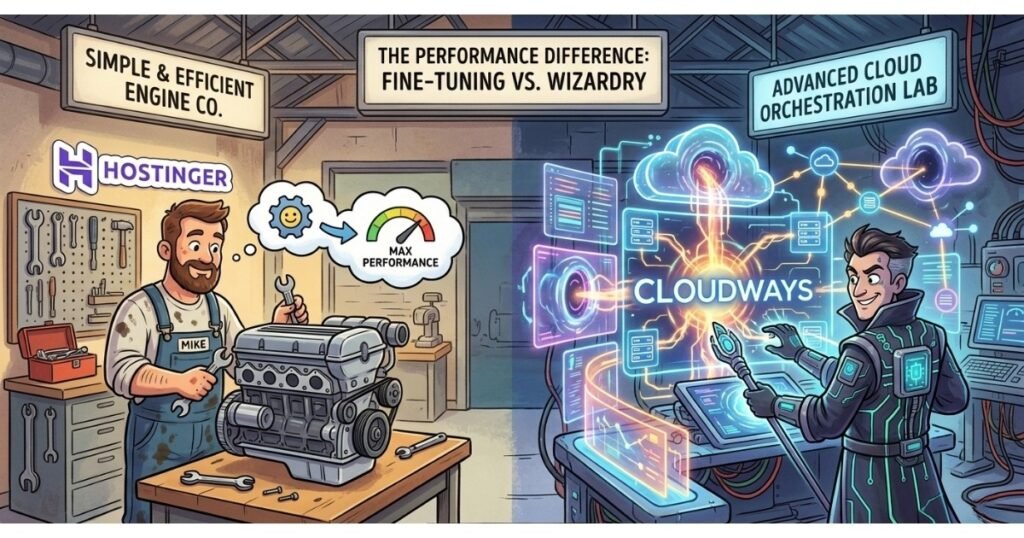
The primary differentiator between these two platforms lies within their core software stacks and how they utilize hardware resources.
Hostinger: Tightly Controlled Ecosystem with LiteSpeed
Hostinger has built its web hosting platform around a highly optimized, single-tenant and multi-tenant environment managed entirely in-house. Rather than relying on traditional Apache or standard Nginx setups, Hostinger utilizes the LiteSpeed Enterprise Web Server (LSWS) across its Business and Cloud plans.
This infrastructure configuration yields specific performance advantages:
- Event-Driven Architecture: LiteSpeed replaces Apache processes with an event-driven framework, drastically reducing RAM and CPU overhead when serving concurrent requests.
- Native LSCache Integration: Caching is executed at the server level rather than the application layer, avoiding the resource-heavy PHP execution cycles required by standard WordPress caching plugins.
- Streamlined Control via hPanel: Many traditional hosting panels (like cPanel) run heavy background processes. Hostinger’s proprietary hPanel is designed to be lightweight, preserving maximum compute resources for website processes and MySQL database execution.
Cloudways: Cloud Orchestration and the Lightning Stack
Cloudways operates as an abstraction layer over premier cloud infrastructure providers, including DigitalOcean, Vultr, Amazon Web Services (AWS), and Google Cloud Platform (GCP). Users do not receive root server access, but they gain a highly sophisticated environment optimized specifically for performance.
Cloudways deploys its proprietary Lightning Stack across all cloud nodes:
- Nginx and PHP-FPM: The modern Cloudways architecture utilizes Nginx as a high-concurrency reverse proxy paired directly with PHP-FPM to execute dynamic code efficiently.
- Advanced Memory Caching: Every server deployment includes pre-configured Redis Object Cache Pro and Memcached instances to accelerate database query performance.
- Isolated Cloud Resources: Because deployments live on dedicated cloud nodes, there is zero resource contention from neighboring sites, ensuring predictable CPU and RAM allocations.
Empirical Network Telemetry: Speed and Load Testing

To understand how these architectural choices translate into real-world user metrics, we analyze the two most critical Core Web Vitals: Time to First Byte (TTFB), which measures server responsiveness, and Largest Contentful Paint (LCP), which measures perceived loading speed.
Real-World Performance Benchmarks
The data below outlines the performance behavior of a standard, dynamic e-commerce application under a simulated test of 50 concurrent virtual users.
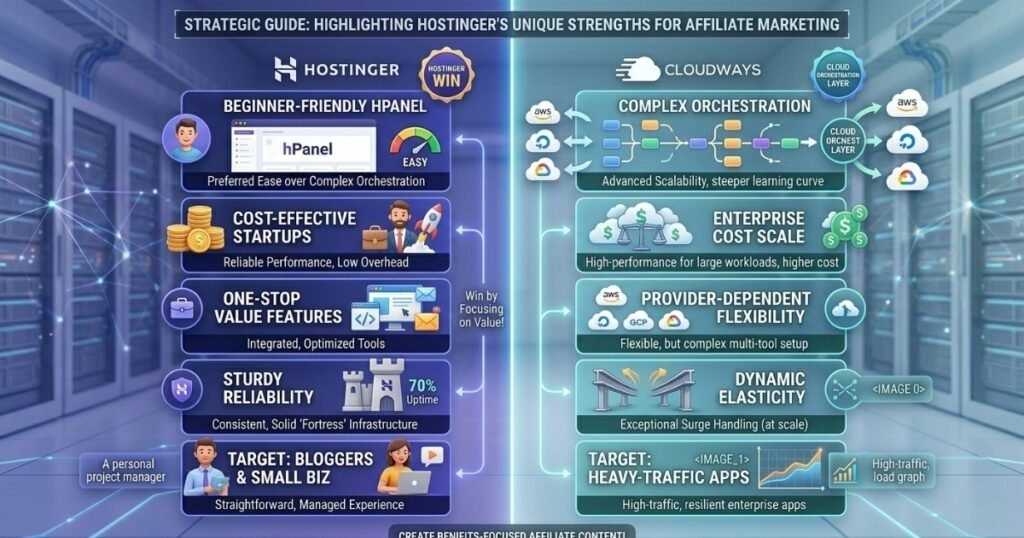
Analyzing the Telemetry
Hostinger delivers highly competitive TTFB scores when users hit data centers within their selected geographic zone, primarily because LiteSpeed handles incoming connections rapidly.
However, Cloudways consistently edges ahead in global response times and processing capacity under load. Because Cloudways environments live on dedicated cloud instances with native Nginx configurations, they process complex PHP loops and concurrent database queries with lower latency overhead.
Stress Testing and Linear Stability Under Concurrent Load

A hosting environment cannot be judged solely by its performance during quiet traffic periods. True architectural resilience is demonstrated when a marketing campaign, viral post, or seasonal promotion drives thousands of sudden visitors to a site simultaneously.
Hostinger’s Ceiling
During a sustained traffic spike, Hostinger relies on its LiteSpeed web server to recycle worker processes efficiently. This prevents the server from crashing under moderate spikes. However, because hardware limits are fixed based on the chosen tier (e.g., specific allocations of RAM and CPU cores on their hPanel ecosystem), a massive, unexpected surge will eventually hit a hardware bottleneck, resulting in an artificial queue and increased page response times.
Cloudways’ Elastic Scalability
Cloudways handles traffic volatility through a process called Vertical Scaling. Because the management layer interacts directly with cloud provider APIs, administrators can scale server resources (RAM and CPU) dynamically from the dashboard with minimal disruption. Combined with native server-side caching tools like Redis and an optional Cloudflare Enterprise edge integration, Cloudways absorbs massive transaction volumes by distributing the compute load across cloud data networks.
Security Frameworks and Automated Core Protections
Security measures can actively degrade server performance if they are implemented poorly at the application level. Both platforms counter this by implementing automated security protocols within the infrastructure itself.
Hostinger’s Security Perimeter
Hostinger deploys security tools natively across its hardware network. This includes:
- Automated firewalls and anti-DDoS mitigation at the network switch level.
- Malware scanning powered by centralized server tools that run without draining individual account resources.
- Automated daily or weekly snapshots stored on isolated backup arrays.
Cloudways’ Layered Defenses
Cloudways takes a decoupled approach to platform security by combining infrastructure-level protections with application isolation:
- OS-Level Firewalls: Every cloud node is protected by a dedicated firewall that filters malicious traffic before it reaches the Nginx web server.
- Fail2Ban Implementation: Automated rate-limiting systems monitor authentication logs, instantly blocking brute-force IP addresses to prevent automated bots from consuming server CPU cycles.
- Cloudflare Enterprise Integration: Users can route traffic through a premium edge network, offloading web application firewall (WAF) checks and DDoS filtering entirely to Cloudflare’s global edge nodes before the traffic ever reaches the origin cloud server.
Architectural Verdict: Choosing Your Infrastructure

While both Cloudways and Hostinger deliver excellent uptimes and fast loading speeds, they serve fundamentally different operational models.
Choose Hostinger if:
- You are managing standard business websites, portfolios, or growing content blogs that require reliable speed with predictable, fixed monthly expenses.
- You prefer an all-in-one control panel (hPanel) that handles domain management, web hosting, and email configuration out of a single dashboard.
- You want the speed benefits of an Enterprise LiteSpeed server environment without needing to configure advanced caching frameworks manually.
Choose Cloudways if:
- You are a developer, agency, or e-commerce business owner managing high-traffic WooCommerce applications that experience volatile traffic spikes.
- You require deployment flexibility, allowing you to choose distinct data center nodes across AWS, GCP, or DigitalOcean based on client location or specific infrastructure requirements.
- Your workflow demands staging environments, dedicated Git integration, isolated cloud resource scaling, and advanced server-side tools like Redis Object Cache Pro.

Hi, I am Priyanka Roy, an SEO Specialist and Content Writer at Sandhu Marketing Agency Inc.. For the past 4 years, I have been helping businesses improve their websites and grow their organic traffic through practical and effective SEO strategies.
I enjoy working on different SEO tools and exploring how they actually perform in real situations. Over time, I have tested many tools, faced real challenges, and learned what works and what does not. This is exactly what I share on Savenjoy. My goal is to help you understand what to expect from a tool before you spend your money on it.
Instead of just listing features, I focus on real experiences, honest insights, and simple explanations so you can make better decisions with confidence. All I want is to make your journey easier and smarter.
I love trying new digital tools even when I do not need them, just to see if they are worth it or not.