⚠️ Affiliate Disclosure: We earn a commission on purchases made via our links — at no extra cost to you.

NordPass vs Bitwarden: Free vs Paid Compared
Choosing the right tool to secure digital credentials can be challenging when so many applications make identical safety claims. Traditional browser password storage options lack the isolation required to resist modern malware strains, making an independent manager a necessary investment for digital safety. NordPass and Bitwarden represent two different structural approaches to consumer encryption and data management. This evaluation provides a deep dive into their distinct service designs, core structural limitations, and true long term costs to help determine which architecture fits your personal security model.
For individuals seeking a rapid summary, Bitwarden provides the most functional free tier on the market by allowing unconstrained multi-device use without charge. NordPass focuses its efforts on a polished application interface and seamless user interactions that justify its subscription cost for less technical users.
Understanding the Free Tiers
The functional divide between these two services is most visible when assessing what features remain accessible without a financial subscription. NordPass runs its free application tier under a restrictive device limitation model designed to encourage premium upgrades. While you can install the application on multiple machines, you are permitted only one active connection session at any given moment. Authenticating into the application on a mobile phone will immediately invalidate the session on a desktop browser extension, requiring a repetitive login loop that complicates fluid, daily cross platform workflows.
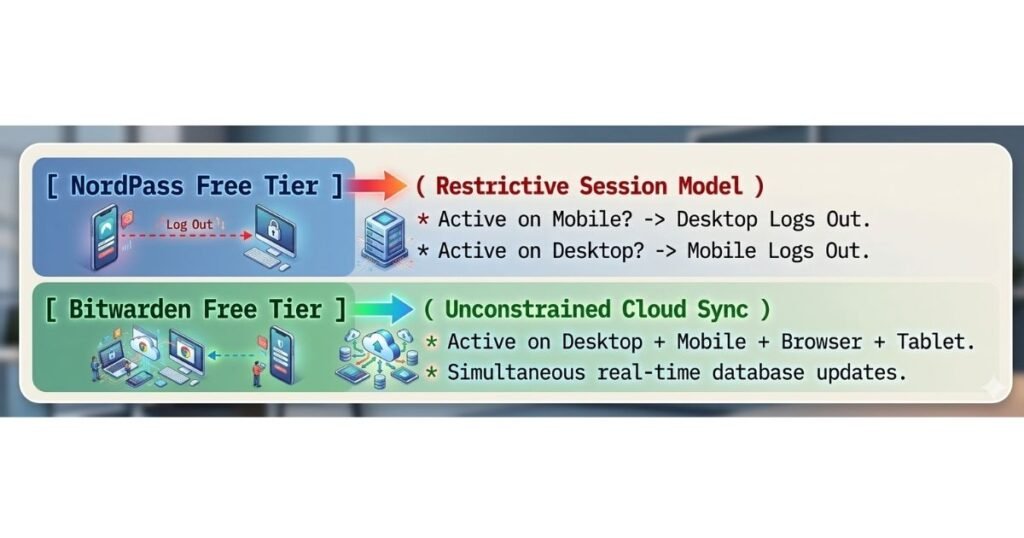
Bitwarden approaches its free service level with a fundamentally different operational philosophy by granting unlimited entry storage across an infinite number of operational platforms simultaneously. Free tier users receive real time database updates across browsers, desktop environments, and mobile operating systems without encountering session termination roadblocks. Both software suites include core baseline utilities like credential autofill engines and biometric authentication integrations to handle local device security. However, the operational reality of the NordPass system restriction turns its free platform into an introductory evaluation tool rather than a permanent daily utility.
Exploring Paid Premium Features
Upgrading to a paid subscription changes the capabilities of both platforms by introducing active scanning tools and administrative account recovery structures. Premium accounts unlock continuous data breach monitoring networks that search historical credential dumps and known dark web repositories for exposed customer emails. Users receive automated system alerts if their information is leaked, alongside proactive password health reports detailing which database entries are structurally weak, outdated, or duplicated across multiple web applications. Secure document and file storage allocations are also upgraded, allowing clients to encrypt sensitive materials alongside text entries.
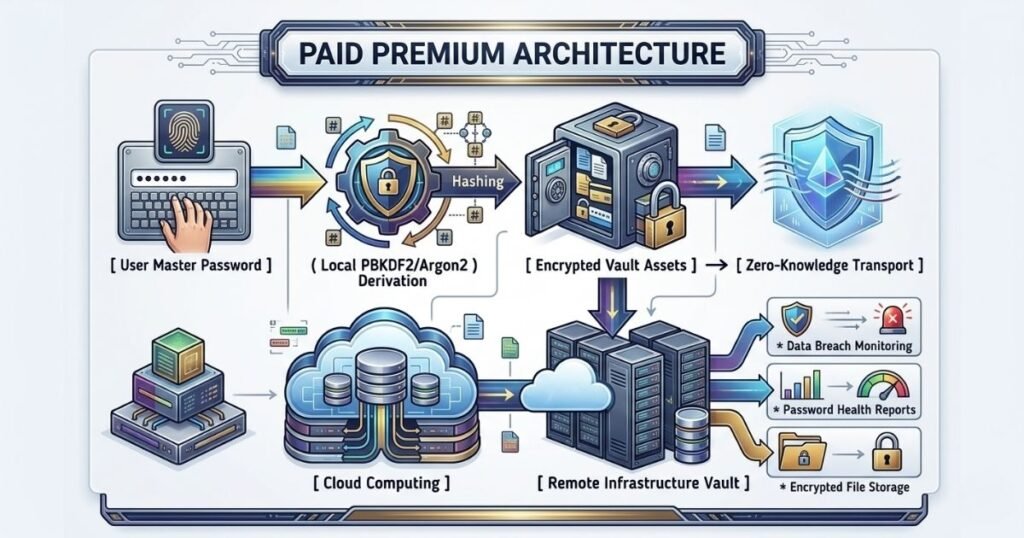
Both service providers build these expanded premium platforms on a foundations of zero knowledge architecture. This operational standard ensures that customer records are transformed into unreadable ciphertext on the local machine using an encryption key generated directly from the user master password before any data transits to corporate cloud servers. Because neither company retains a copy of the decryption key on their remote systems, corporate employees cannot access the underlying vault items. This setup preserves consumer privacy during data transit, keeping user data secure even if the cloud service provider suffers a direct server room breach.
Security Infrastructure and Encryption Standards
The underlying mathematical choices separating these two tools highlights a significant shift in corporate design philosophies. Bitwarden relies on the traditional advanced encryption standard utilizing two hundred and fifty six bit key lengths, a cryptographic benchmark backed by decades of international government and corporate deployments. NordPass uses the newer XChaCha20 encryption protocol, which is a stream cipher system gaining rapid adoption across modern cloud architectures due to its efficiency on mobile processor units. This protocol operates with lower processing overhead than traditional block ciphers and avoids certain implementation vulnerabilities when deployed on diverse consumer hardware sets.
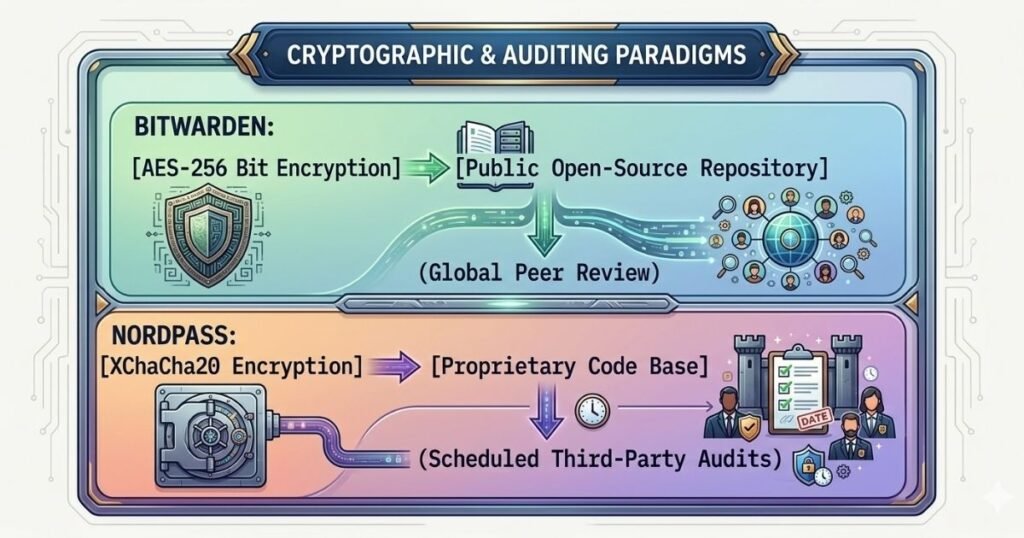
The approach to verification provides another clear point of differentiation between the two services. Bitwarden publishes its entire framework as open source code, allowing independent developers, security researchers, and community auditors to review the repository for security vulnerabilities. This transparency reassures privacy purists that the software does not contain hidden backdoors. NordPass operates as a closed proprietary system managed under the Nord Security brand ecosystem, relying instead on scheduled third party security audits from independent compliance firms to verify its architectural safety claims to the public.
Comprehensive Comparison List
- Bitwarden offers unrestricted database record propagation across an infinite number of simultaneous desktop, browser, and mobile client instances without charging an access fee.
- NordPass terminates the alternative system connection whenever a user authenticates on a new machinery group while running their unbilled application tier.
- Bitwarden relies on a fully open source application distribution system where global privacy communities inspect the compilation scripts for operational errors.
- NordPass maintains a proprietary, closed code design that is validated through contracted external professional corporate security assessments.
- Bitwarden includes an integrated time based one time password authenticator engine within its premium tier to centralize multi factor token generation.
- NordPass provides a dedicated email masking module inside its paid subscription to help users create private tracking aliases during new account registrations.
- Bitwarden provides self hosting capabilities for advanced users who want to deploy the password infrastructure on their own home server networks.
- NordPass relies on a centralized cloud architecture managed inside the proprietary company data server system.
Price List and Value Analysis
The financial structures of these two platforms reflect their corporate backgrounds, with one favoring flat pricing and the other utilizing subscription promotional models. Bitwarden uses a highly transparent pricing model, offering an individual premium tier at a fixed rate of one dollar and sixty five cents per month, billed as an annual payment of nineteen dollars and eighty cents. Their family package costs three dollars and ninety nine cents per month and covers up to six separate users with shared organizational folders. This straightforward approach provides predictable ownership costs, avoiding unexpected price jumps when the subscription rolls over at the end of the year.
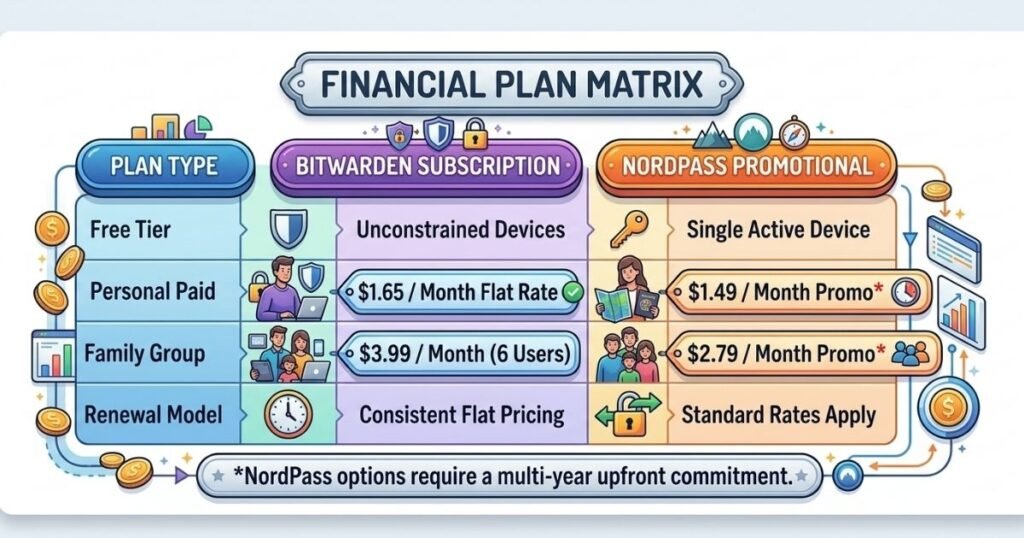
NordPass structures its pricing using introductory discounts linked to multi year upfront commitments, often dropping individual accounts down to one dollar and forty nine cents per month on a two year contract. Their family plan options follow a similar promotional track, averaging two dollars and seventy nine cents per month for a twenty four month service agreement. However, users need to account for standard renewal adjustments once the initial contract period concludes. When these promotional terms end, standard service rates apply, which can alter the long-term cost comparison relative to Bitwarden.
Final Selection Guide and Verdict
Choosing between these password managers ultimately depends on your personal technical comfort and your budget. Bitwarden is an excellent fit for cost conscious consumers, privacy purists, and technical administrators who want open source code validation and a highly capable free tier. Its interface favors function over form, providing a straightforward tool for users who prioritize software transparency and low long term pricing. It delivers exceptional security value without forcing customers into restrictive multi year contracts.
NordPass is well suited for individuals who want a polished user interface, helpful onboarding guides, and a streamlined layout that fits easily into a modern software ecosystem. If you want a user-friendly, set it and forget it application and do not mind paying a subscription fee for multi-device access, NordPass is a strong choice. Both tools provide excellent zero knowledge protection, so your decision can come down to whether you prefer open source utility or a premium user experience.

Hi, I am Priyanka Roy, an SEO Specialist and Content Writer at Sandhu Marketing Agency Inc.. For the past 4 years, I have been helping businesses improve their websites and grow their organic traffic through practical and effective SEO strategies.
I enjoy working on different SEO tools and exploring how they actually perform in real situations. Over time, I have tested many tools, faced real challenges, and learned what works and what does not. This is exactly what I share on Savenjoy. My goal is to help you understand what to expect from a tool before you spend your money on it.
Instead of just listing features, I focus on real experiences, honest insights, and simple explanations so you can make better decisions with confidence. All I want is to make your journey easier and smarter.
I love trying new digital tools even when I do not need them, just to see if they are worth it or not.