⚠️ Affiliate Disclosure: We earn a commission on purchases made via our links — at no extra cost to you.

The Ultimate Guide to Online Case Converters: Master Your Text Formatting in Seconds
Contents
hide

In today’s fast-moving digital environment, managing text efficiently is not just helpful but essential for productivity. Whether you are a content creator, student, marketer, or data professional, dealing with inconsistent formatting can slow down your work significantly. This is where a case converter becomes an indispensable solution. Instead of manually editing text line by line, a reliable case converter online tool allows you to transform entire paragraphs in seconds with complete accuracy. From fixing accidental capitalization errors to standardizing documents, this simple yet powerful utility helps you maintain consistency across all types of content. As digital workflows become more demanding, tools like a case converter tool are no longer optional but a core part of efficient work systems.
What is a Case Converter and Why It Matters

A case converter is a web-based or software-driven utility that changes the capitalization format of text automatically. It can instantly convert lower case to upper case, sentence case, title case, or even apply an all caps converter format depending on your needs. This functionality becomes extremely valuable when working with large volumes of text where manual editing would be time-consuming and error-prone. For example, when copying data from PDFs or spreadsheets, formatting often breaks, leading to inconsistent capitalization. A capitalization converter solves this problem instantly by applying uniform rules across the entire text. This ensures that your content looks professional, readable, and aligned with formatting standards, which is especially important in business communication, academic writing, and digital publishing.
How a Case Converter Works Behind the Scenes

At a technical level, a case converter operates using string manipulation logic based on character encoding systems like ASCII or Unicode. While this may sound complex, the actual process is very fast and efficient. When you input text into a case converter online tool, it scans each character and determines whether it should be converted based on the selected format. For instance, if you choose to convert lower case to upper case, the system replaces each lowercase letter with its uppercase equivalent instantly. This process happens directly in your browser in most modern tools, ensuring speed and data privacy. Because of this lightweight processing, even large text blocks can be transformed within seconds without any performance issues, making it ideal for professionals handling high-volume data.
Common Types of Case Conversion You Should Know

Understanding different formatting options helps you use a case converter tool more effectively in real-world scenarios. Each conversion type serves a specific purpose depending on the context of your work.
- Sentence case: This format capitalizes the first letter of each sentence while keeping the rest of the text in lowercase. It is widely used in blogs, emails, and documentation to improve readability.
- Uppercase conversion: This option transforms all text into capital letters. It is useful for headings, labels, and emphasis, especially when using an all caps converter for design or visibility purposes.
- Title case: A capitalization converter applies the title case by capitalizing the first letter of major words. This is commonly used in blog titles, articles, and marketing content.
- Toggle case: This feature flips each letter’s case, making uppercase letters lowercase and vice versa. It is especially useful for fixing typing errors caused by accidental Caps Lock usage.
Each of these formats plays an important role in ensuring your content looks structured, professional, and consistent across platforms.
Real-World Use Cases Where Case Converters Save Time
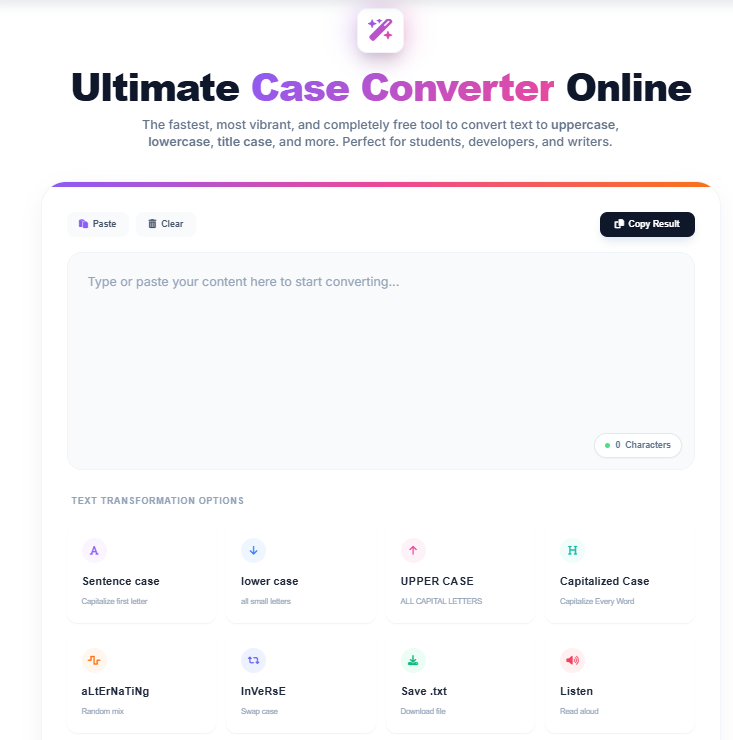
In practical workflows, a case converter is more than just a convenience tool. It becomes a productivity enhancer when used strategically. For instance, when working with Excel datasets, users often search for ways to convert small letter to capital in Excel using formulas like UPPER or LOWER. While these formulas work, they require extra steps such as creating additional columns and managing formulas carefully. A faster alternative is to use a case converter online tool where you can copy data, convert it instantly, and paste it back without complexity. This approach is particularly useful for non-technical users or those handling large datasets. Similarly, content writers and social media managers use case converters to quickly adjust formatting for headlines, captions, and posts, ensuring consistency with brand guidelines.
Benefits of Using a Case Converter Tool
Using a case converter offers several practical advantages that directly impact productivity and content quality.
- Saves significant time: Instead of manually editing text, you can process thousands of words instantly, which is especially useful for bulk content tasks.
- Improves accuracy: A capitalization converter applies consistent formatting rules, eliminating human errors that often occur during repetitive editing.
- Enhances readability: Proper capitalization improves the overall presentation of your content, making it easier for readers to understand and engage.
- No technical skills required: A case converter tool is designed for simplicity, allowing anyone to use it without prior knowledge or training.
These benefits make case converters valuable for professionals across industries, from education and marketing to data analysis and development.
Case Converter vs Excel and Other Alternatives
Many users rely on spreadsheet functions when trying to convert small letter to capital in Excel, but this method has limitations. While Excel formulas like UPPER, LOWER, and PROPER can change text case, they often require additional columns and manual adjustments. This can become inefficient when dealing with large datasets or when quick results are needed. In contrast, a case converter online tool offers a faster and more flexible solution by allowing instant transformation without altering the original data structure. Similarly, word processors like Microsoft Word provide basic case conversion features, but they lack the speed and versatility of dedicated tools. For advanced workflows, especially those involving bulk content or repetitive formatting tasks, a specialized case converter provides a more streamlined and user-friendly experience.
Limitations You Should Be Aware Of
While a case converter is highly useful, it is important to understand its limitations to use it effectively. These tools primarily focus on changing letter case and do not correct grammar, spelling, or contextual errors. For example, a capitalization converter may not always follow complex style guidelines perfectly, especially in cases where language rules vary. Additionally, while most modern tools support multiple languages, some may produce inconsistent results depending on language-specific capitalization rules. Another limitation is that formatting beyond text case, such as font styles or spacing, is not affected. Being aware of these factors helps you combine case converters with other tools when necessary for complete content optimization.
Why Savenjoy’s Case Converter Tool Stands Out
Among various tools available, Savenjoy’s case converter tool is designed with a strong focus on performance, usability, and privacy. It processes text directly in the browser, ensuring that your data is not stored or shared, which adds an extra layer of trust. The interface is clean and distraction-free, allowing users to focus entirely on their task without unnecessary elements. Whether you are using it as an all caps converter or a capitalization converter, the tool delivers instant results without lag. It also supports large text inputs, making it suitable for both small edits and bulk processing. These features make it a reliable choice for professionals who prioritize speed, simplicity, and data security in their workflow.
Final Thoughts
A case converter is more than just a simple utility. It is a practical solution for improving efficiency, reducing errors, and maintaining consistency in digital work. Whether you need to convert lower case to upper case, fix formatting issues, or streamline your workflow, a reliable case converter online tool can make a significant difference. By understanding its features, benefits, and limitations, you can use it more effectively in your daily tasks. As digital work continues to evolve, adopting tools that save time and improve accuracy is essential for staying productive and competitive.
FAQs
Does a case converter change symbols or numbers?
No, a case converter only modifies alphabetic characters. Symbols, numbers, and special characters remain unchanged, ensuring data integrity.
Can I use it for foreign languages?
Yes, most modern converters support Unicode, which means they can handle multiple languages. However, results may vary depending on language-specific capitalization rules.
Is there a limit to the word count?
Most high-quality tools can handle large volumes of text. However, performance may depend on your browser and device capabilities.

Hi, I am Priyanka Roy, an SEO Specialist and Content Writer at Sandhu Marketing Agency Inc.. For the past 4 years, I have been helping businesses improve their websites and grow their organic traffic through practical and effective SEO strategies.
I enjoy working on different SEO tools and exploring how they actually perform in real situations. Over time, I have tested many tools, faced real challenges, and learned what works and what does not. This is exactly what I share on Savenjoy. My goal is to help you understand what to expect from a tool before you spend your money on it.
Instead of just listing features, I focus on real experiences, honest insights, and simple explanations so you can make better decisions with confidence. All I want is to make your journey easier and smarter.
I love trying new digital tools even when I do not need them, just to see if they are worth it or not.